
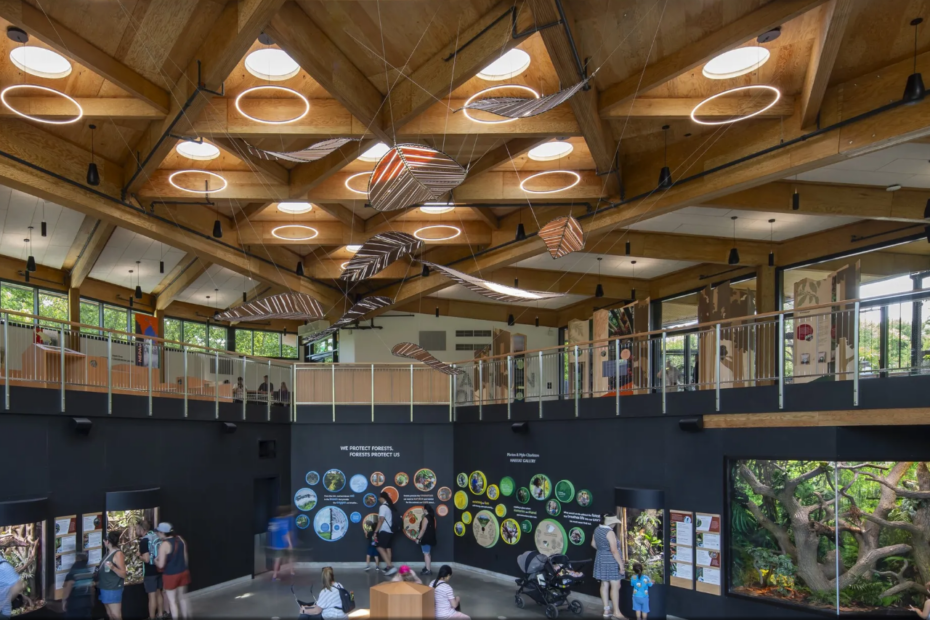
Most construction already banks heavily on wood in the form of small dimensional lumber; the mass timber movement is focused on much bigger components made by gluing layers of smaller pieces of wood together. Cross-laminated timber and glue-laminated timber, two of the most common mass timber building products today, can be used for the columns, beams, walls and floor decks of buildings.
“In so much architecture today, the structure gets covered up,” says Jeremy Schoenfeld, an associate at LMN, another Seattle firm leading the local embrace of the new building approach. “Mass timber allows us to expose the structure and make it the beautiful thing about a building.”
Beauty aside, exposed structures mean using less material for surface finishes, further reducing a building’s carbon footprint. That’s a big deal. The construction industry accounts for about 40% of all global carbon emissions today.
Mass timber buildings offer a more sustainable path forward. Steel and concrete release large amounts of greenhouse gases — think of the energy required to mine and transport raw materials, then manufacture and ship finished products to a building site. Mass timber is different: Trees absorb carbon dioxide as they grow, and when they’re harvested and made into CLT, that carbon stays locked inside the wood, turning buildings into carbon sinks.